Working Notes 02.12.2024
“What do you represent?”

0. Vorstellung / What do you represent?
Vorstellung / feminine noun
# idea; picture; illusion; imagination
# showing, performance
# introduction; presentation; interview
# objection, protest.
— — —
“Evenness and openness did seem to mean better painting — had not that been Braque’s essential proposal to Picasso for the preceding three years? — but they also meant empyting, reducing, diagrammatizing, blanking out.”
– T. J. Clark: ’Cubism and Collectivity’ in ‘Farewell to an Idea, Episodes from a History of Modernism’, Yale University Press, 1999, p192
[–> return to this]
Schopenhauer’s “abstract objects” / “objects that are not spatiotemporal, which do not stand in causal relationship with anything, and which have not been abstracted like a concept, but rather, are the real, objective, essential aspects of the world as representation as perceived by a will-less subject. The crucial role that they play in Schopenhauer’s system is that they are the objects of all aesthetic experience—both of the artist and spectator—and their perception constitutes insight into the essential nature of the phenomenal world.”
“It is the aesthetic, intuitive factor that is declared to be ultimately real, while the theoretically designated factor in our experience is only relatively so.”
– Guenther: ‘Buddhist Philosophy in Theory and Practice’, 1971
[without the resonant contemplative practices, the nature of phenomena as a spontaneous, empty, indeterminate play cannot be revealed / access to pristine cognition / ye-shes; jñāna]
1. Braque

Georges Braque: ‘Bouteille et instruments de musique’, 1918, crayon, charcoal and white chalk on collaged paper and corrugated cardboard, 53 x 75 cm and ‘Rhum et guitare (Rum and Guitar)’, 1918, oil on canvas, 60 x 73 cm, Colección Abelló, Madrid.
Then the gray sky, heavy and charged with mystery, suddenly brightens. The most essential elements of the vocabulary free themselves. 1911, ’12, ’13. Miraculous stripping down to simple forms in light. Stark and luminous designs—already the undeniable mastery of the mind released from the efforts of a silent and dangerous struggle against the opaque and hermetically sealed mass of matter. …the new words, are detached, the lines of objects of the new language begin to take shape. Mastery of the new expression is achieved. A totally new art, powerful and marvelously plastic, is established.
I pity those who, having witnessed this marvelous period, failed to share not merely in its often disheartening, painful tribulations but also, at the same time, in its incomparable emotional power and spiritual bliss.
[. . .]
…here, for the first time in history, the painting as object was put on display—no longer an artificially luminous object, falsely playing its part in a corner of reality, but a real object, well defined, possessing flatness and coloration, unafraid to receive rays of actual light on its surface.
[. . .]
When we realize that indeed what produces the indefinable strangeness we found in those paintings, leaving us with a certain unease, is above all that unequal battle waged between the light with which they were supposedly endowed-and which dies away more and more each day-and the eternal explosion, always the same, always renewed, of natural light. We will see, we already see, but one day we’ll see better still, that in these newer paintings—which, by contrast, present themselves, like all other real objects, in their ingenuous nudity and flatness—the light is on the inside, in the relations between diverse elements: spiritual light.
– Pierre Reverdy: ‘Georges Braque ‘Une aventure méthodique’, 1949 (‘A Methodical Adventure’, BSE Books, 2020, pp36-39)
LINK: 04. BRAQUE | CARL EINSTEIN
2. Einstein
Rupture — Totality — Zing!
“…the work breaks the continuity of reality, the notion of aesthetic autonomy is reinterpreted in terms of a dynamic and subversive process. For the poet, the setting in motion of the pictorial space, far from giving access to a new legibility of the world, brings with it the very integrity of the psyche. The totality of the work, like that of the spectator’s consciousness taken to task in the act of seeing, is a totality which ‘melts into the current of its fragments’.”
– Marcella Lista: ‘Carl Einstein. Georges Braque’, CRITIQUE D’ART 22, Automne 2003
[138]
[quote] “What constitutes totality is that a complex, unified structure is grasped in a form. In human things and our will, there seems to be an urge to create, the will to form. [. . .] We establish totality — when we grasp a thing in a unified combination — in a precisely delimited and specific way — when it forms a whole in itself. Totality is not just any concept but the determination of our will.” [Fragment, Werke IV, pp124] / Totality as artwork is both the goal and the process / understood as both whole and fragment / the fluctuating and variable process of reality which cannot be limited to a certain system or worldview.
[149]
making this cut, or rupture in the continuity of time
[185]
the rips in the continuity of representation / the potential for freedom: now! / the psycho-physical revolutionary program of zing!, the permanent aria da capo of >>aha!<< in the unmoored, and perhaps frightening marvel of immanence. / an autonomous aesthetic becomes the immanent ordering of the real / The hallucination, this iconoclasm of the inner-image of the subject/object dichotomy, indicates the complex, material yet ephemeral production of vision as yet-to-be-determined >world to come< / breaking apart of contemplation is the speculative and perhaps even revolutionary moment of intuition and production of utopia breaking away from the regulative orders which harness now!
[186]
…to change and bring about a world, hinting at and realised in the fleeting zing of experience. / now! is the material epiphany of the crossroads of revolution (the production of reality) and submission (the fabrication of fiction) / The untimely now and the dislocated >here< both are the result of overturnings of the judgment of the sovereign subject, and thus could be pursued as a particular revolution of the conditions of life. / this rare and exciting event is surrounded on all sides by more mundane concerns.
– David Quigley: ‘Carl Einstein A Defense of the Real’, Akademie der bildenden Künste Wien, 2007
3. Popova
(Form + color + texture + rhythm + material + etc.)
× ideology (the need to organize)
= our art.
…can we build our new life and new worldview.
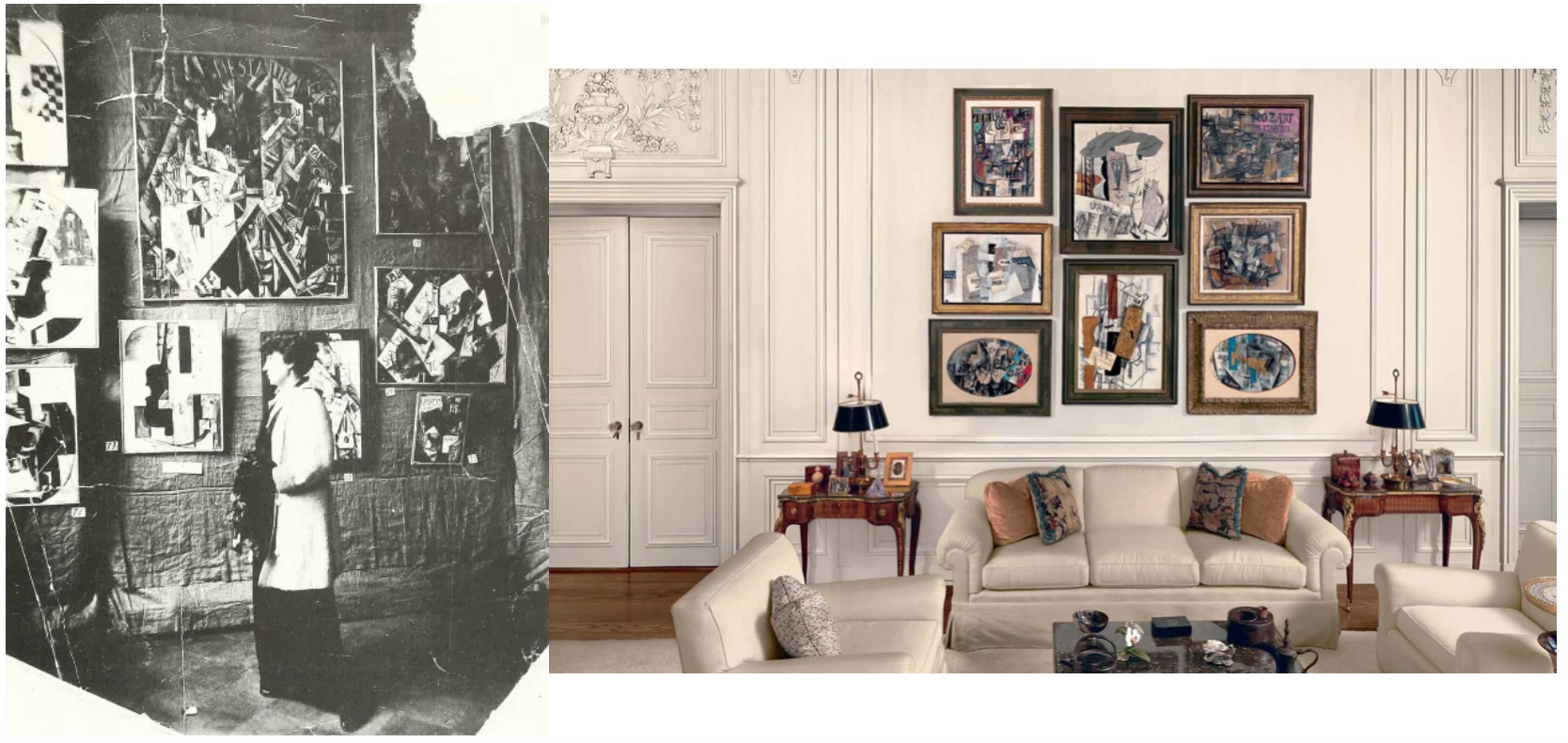
Images: The Charnel House and the Leonard A. Lauder Collection (The Met, NY)
More than anyone else, the artist knows this intuitively and believes in it absolutely. That is exactly why artists, above all, undertook a revolution and have created — are still creating — a new worldview. Revolution in art has always predicted the breaking of the old public consciousness and the appearance of a new order in life.
…this [new] form has declared the end not only of the old art, but perhaps of art in general or, if not the end, then an artistic transformation so great that it cannot be accommodated within the old conception of art.
[. . .]
Through a transformed, [more] abstract reality, the artist will be liberated from all the conventional worldviews that existed hitherto. In the absolute freedom of non-objectivity and under the precise dictation of its consciousness (which helps the expediency and necessity of the new artistic organization to manifest themselves), [the artist] is now constructing [his/her] own art, with total conviction.
[. . .]
The more organized, the more essential the new forms in art, the more apparent it will become that our era is a great one and indispensable to humanity.
– Liubov Popova: ‘On organizing anew’ , circa 1921 / accessed 28.11.2024]
4. Barnett Newman | [notes on Lyotard]
“…if we refuse to live in the abstract, how can we be creating a sublime art?”
– Barnett Newman: ‘The Sublime is Now’, 1947
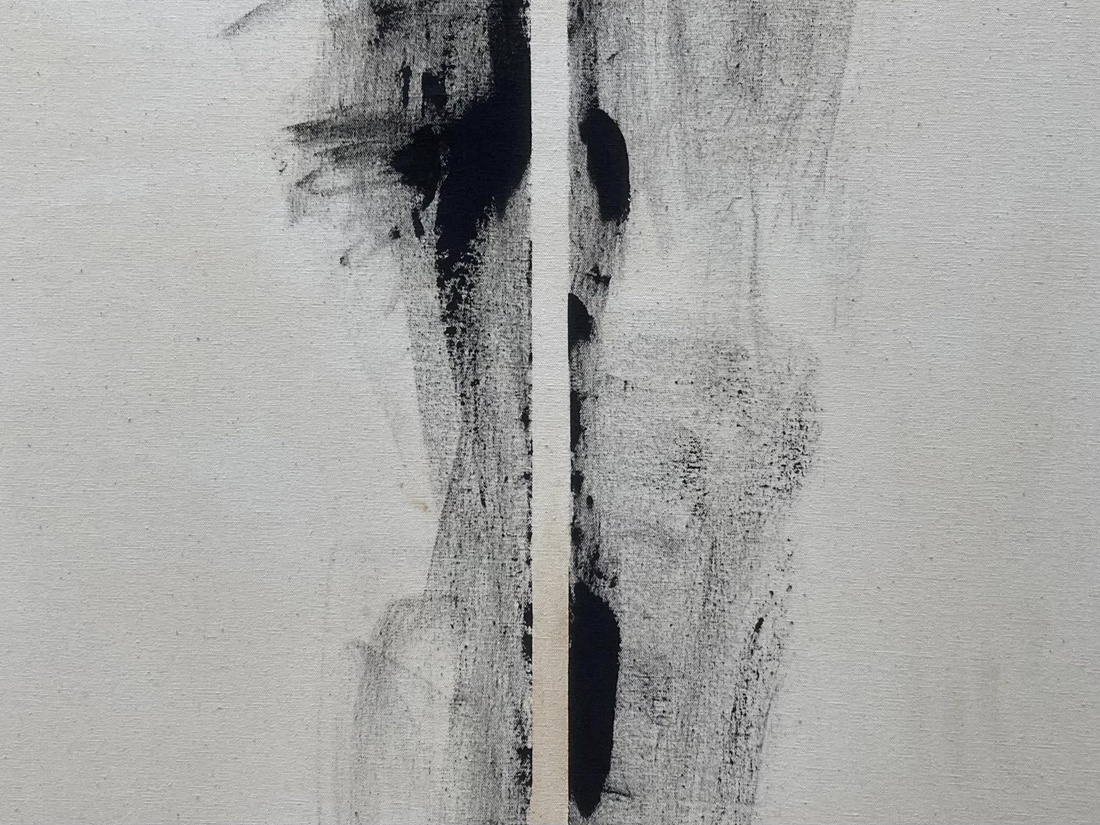
Barnett Newman’s Stations of the Cross (Lema Sabachthani), National Gallery of Art, Washington DC / 28.09 & 01.10.2024
Here and Now, Right Here, Not There — Here / it can only “take-place” = “an instant” [the lapse of that succession] + “presence” = a mindless state of mind = a ‘mind’ not for matter to be perceived or conceived, given or grasped, but ‘so-that-there-be-some-something” = ‘it is there’ = (Voilà)
…it can only “TAKE PLACE” = “an instant” + “presence” = “so that there be”
the sublime = feeling of “there” [Voilà] = an occurrence = the instant is instantaneous / no longer the “presentation of the unpresentable” but by the presentation itself

Barnett Newman’s Stations of the Cross (Lema Sabachthani), National Gallery of Art, Washington DC / 28.09 & 01.10.2024
“instant” = the lapse of that succession / ‘The Instant: Newman’ = “sublime” and “immaterial matter” / Newman’s painting = “plastic nudity” (sa nudité plastique) opposed to the “histories or stories” (histoires) of painting = engendering the astonishment of “there” = “a face-to-face relationship, in the second person” = it is there = (Voilà)
‘material’ = the presentation itself / ‘form’ = the means of the presentation
“immaterial matter” (matière immatérielle) = never objectified / un-objectable
“immaterial” / un-objectable = it can only “take-place” = “an instant” + “presence” = a mindless state of mind = a ‘mind’ not for matter to be perceived or conceived, given or grasped, but “so that there be” (some something) / the presence of the matter = the trigger of the sublime
Newman = reducing the event-bound time [temps événementiel] / chromatic matter alone and its relationship with the material […] and the lay-out […] the wonder that there should be something rather than nothing.
Links:
‘Cathedra’ | Stedelijk, Amsterdam, 14.08.2024
‘Stations’ | National Gallery of Art, Washington DC, 28.09 & 01.10.2024
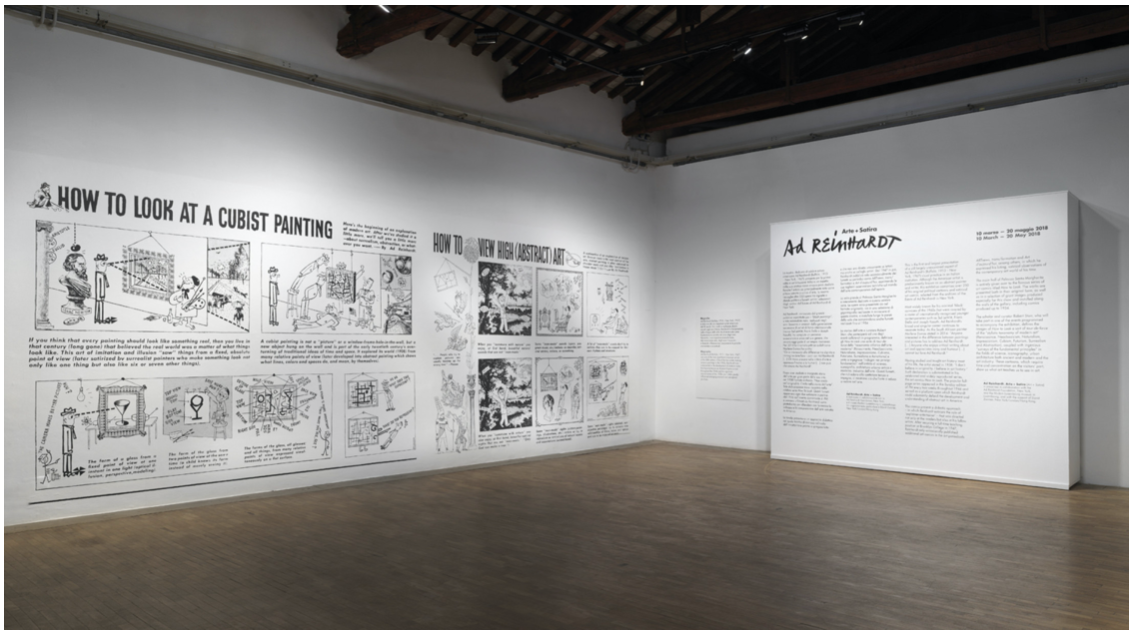
5. Reinhardt
To be part of things or not to be part or having been part of things as they may become, to part from that part that was part of things as they are or not to part?
– Ad Reinhardt: TO BE PART OF THINGS . . . | Unpublished, undated notes
LINK: https://davidpattenwork.com/wp-content/uploads/2020/07/reinhardt-individual-05.04.2014.pdf
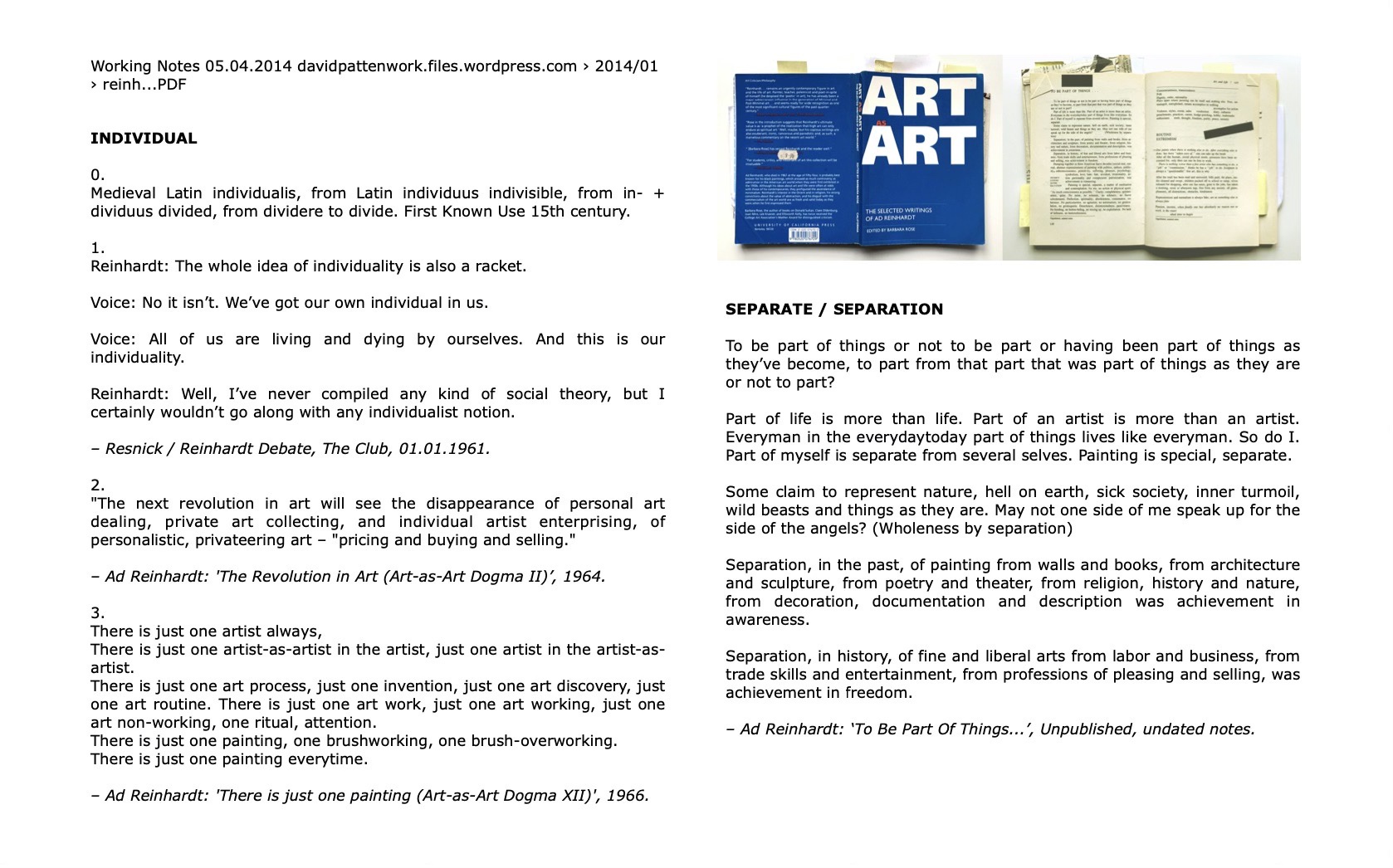
World of art | World-art | The other world [‘Prophetic Voices’]
LINK: https://davidpattenwork.com/wp-content/uploads/2020/07/ad-reinhardt_prophetic-voices_2016.pdf

– Ad Reinhardt: Unpublished, undated notes in Barbara Rose: ‘Art As Art’, University of California Press, 1991, pp129 & 130 and published as ‘SHAPE? IMAGINATION? LIGHT? FORM? OBJECT? COLOR? WORLD?’ in Ned O’Gorman: ‘Prophetic Voices, Ideas and Words on Revolution’, Random House Inc. 1969, pp149-153
6. Negri | ‘Art et multitude’
abstract world – committed art …this plunging of our soul into the abstract. [‘Letter to Nanni on Constructing’]
So it became abstract by traversing a real development, by creating a new world through abstraction. [‘Letter to Gianmarco on the Abstract’]
How can the abstract become the subject of praxis? What kind of world does abstraction desire, and how does it desire it? [‘Metamorphoses: Art and Material’]
Art is a collective labour, its matter is an abstract labour. [‘Letter to Nanni on Constructing’ / ‘Art et multitude’] [. . .] Art is, so to speak, always democratic — its productive mechanism is democratic in the sense that it produces language, words, colours, sounds that cluster together into communities, into new communities. …in which abstraction and production are intertwined: the abstraction of the current mode of production and the representation of possible worlds; the abstraction of the image and the use of the most varied materials; the simplification of the artistic gesture and the geometric destructuring of the real, and so on and so forth. [. . .] A new subject and an abstract object: a subject capable of demystifying the fetishised destiny imposed by capital. [‘Metamorphoses / Dossier: Art and Immaterial Labour’]
Art is, then, one of the products of collective labour. It is this fact, which constitutes its substance, that we are discussing here, my very dear Manfredo. So here we are, in effect ready to live again the sublime rupture from the market, and to remember how, through that ethical decision, we did not abandon the terrain of art, but rediscovered its firmness within human reality. A reality constructed, reconstructed, remodelled by collective labour, a factitious, abstract dimension, a general determination which has invaded everything, body and soul, life and death, and which, above all, has supplanted nature itself, through successive accumulations of abstract labour. All this we know. [footnote 34] …to be capable of a radical break with our reality, of an abandonment and absence that put us once again in contact with the other, with the abandoned friend, with the now dissipated real — to accept the abstraction of the world, to endure its coldness, the desert of the passions. [‘Letter to Manfredo on Collective Work’]
The abstract is our nature, the abstract is the quality of our labour, the abstract is the only community in which we exist. [‘Letter to Manfredo on Collective Work’]
Going beyond the sublime is to go beyond the abstract — not in order to return to the natural, but in order to construct, within the abstract and out of the abstract, a new world. [‘Letter to Silvano on the Event’]
02.12.2024
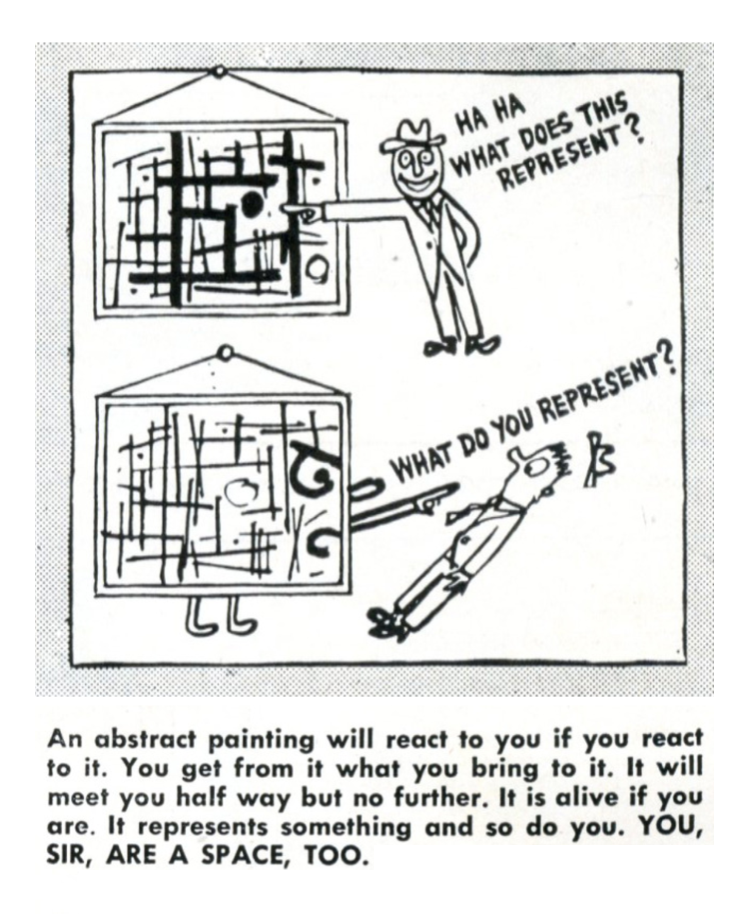
 [ONENESS]